The Building Cost Information Service (BCIS) is the leading provider of cost and carbon data to the UK built environment. Over 4,000 subscribing consultants, clients and contractors use BCIS products to control costs, manage budgets, mitigate risk and improve project performance. If you would like to speak with the team call us +44 0330 341 1000, email contactbcis@bcis.co.uk or fill in our demonstration form
Published: 27/10/2026
ONS publishes quarterly data on housing starts and completions carried out by private enterprises, housing associations and local authorities across the UK.
Data is collected from a range of sources, including local authority new build form returns, National House Building Council (NHBC) data, approved inspector data returns, Scottish Government Affordable Housing Supply Programme and District Council Building Control in Northern Ireland.
As the usage notes for the dataset outline, it provides a timely indicator of new supply, but fuller measures of housing provision come from the separate annual net additions series(1), which also includes conversions, demolitions and changes of use.
Housing starts reached three-year high in second quarter
An estimated 44,700 housing starts were recorded in the UK in 2Q2026, according to the latest provisional data from the Office for National Statistics (ONS)(2). This was the highest quarterly total since 2Q2023, when 80,280 starts were recorded – an exceptional quarter, at the time, when a surge in starts was linked to impending changes in building regulations.
UK housing starts increased by 14.2% compared with 2Q2025 and by 9.4% on the previous quarter. However, activity remained 10.0% below the pre-pandemic level recorded in 2Q2019.
Approximately 44,870 housing completions were recorded in the UK in 2Q2026, broadly unchanged from the same quarter a year earlier but 12.3% higher than completions in 1Q2026. Nevertheless, completions remained 18.8% below their 2Q2019 level.
Starts in England mirrored the national trend, increasing on both the quarter and the year by 11.8% and 20.7% respectively. England also continued to account for the vast majority of UK housebuilding activity. In 2Q2026, it accounted for 86.2% of all UK housing starts, with more than three quarters of those delivered by private enterprises.
In the second quarter, the number of private enterprise starts in England reached 29,670, the highest quarterly total since 2023. By comparison, there were 260 local authority starts and 8,570 housing association starts recorded.
Across the rest of the UK, Northern Ireland was the only nation to record a quarterly increase in housing starts in 2Q2026, despite experiencing the sharpest annual decline, at 33.3%. All other nations recorded declines on both a quarterly and annual basis.
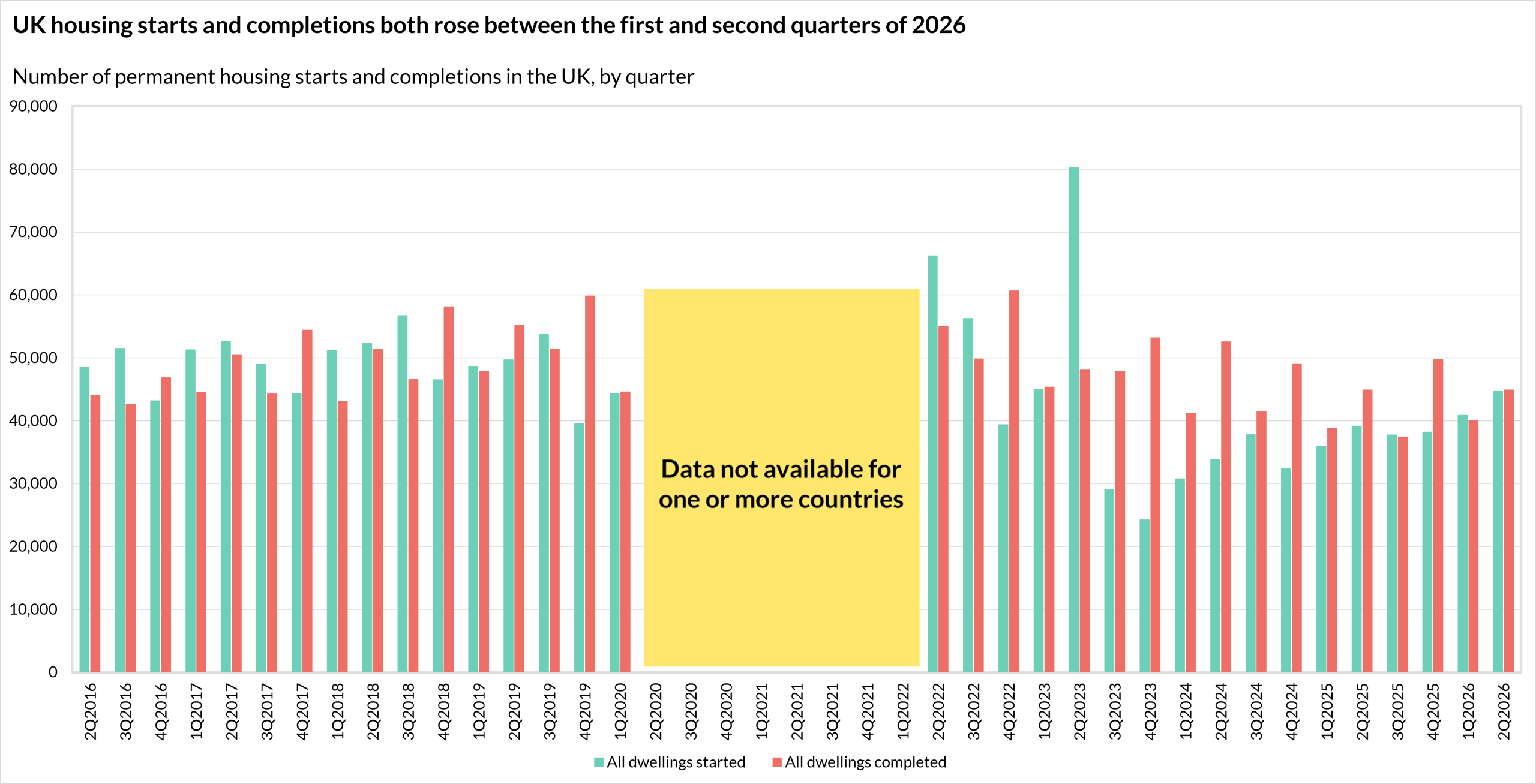
Source: ONS – Indicators of house building, UK: permanent dwellings started and completed by country, Table 1a
Dr David Crosthwaite, chief economist at BCIS, said: ‘There are reports that the government may be quietly abandoning its target of delivering 1.5 million new homes by 2029, and looking at the data, it’s not difficult to understand why.
‘While housing starts and completions improved in the second quarter, the level of housebuilding so far in this Parliament remains significantly below what would be required to meet that ambition. The government’s intentions were ambitious, but the scale and complexity of the challenge may have been underestimated, with unforeseen geopolitical developments, including tensions between the US and Iran, adding further uncertainty and cost pressures to an already challenging environment.
‘The reported additional £1 billion in funding for social and affordable housing in England, expected to be confirmed in tomorrow’s Budget, is a welcome development, although much will depend on how that funding is allocated. Supporting council housebuilding is an important part of the solution, particularly given the government’s ambitions around devolution, local growth and ensuring housing delivery reflects local need.
‘However, councils continue to face significant financial constraints. Many are struggling to balance investment in new development against the rising costs of repairing and maintaining existing housing stock, alongside higher borrowing costs. Expenditure on existing homes is reportedly increasing faster than rental income, reflecting the cumulative impact of historic funding and rent policy decisions. Additional capital funding will help, but is unlikely to deliver a short-term impact.
‘Crucially, the measures the government introduces to support social and affordable housing must be matched by a serious review of the costs and barriers facing private housebuilders. As the latest ONS data illustrates, private enterprise accounts for the overwhelming majority of housing starts and completions in the UK. Without making further development more viable for these businesses, increasing UK housing numbers will likely remain difficult.’
| All housing starts | |||
| 2Q2026 | Change from 1Q2026 | Change from 2Q2025 | |
| UK | 44,700 | 9.4% | 14.2% |
| England | 38,510 | 11.8% | 20.7% |
| Wales | 900 | -16.7% | -17.4% |
| Scotland | 3,780 | -4.3% | -3.1% |
| Northern Ireland | 1,500 | 7.9% | -33.3% |
Source: ONS – Indicators of house building, UK: permanent dwellings started and completed by country, Tables 1a, 1b, 1c, 1d, 1e
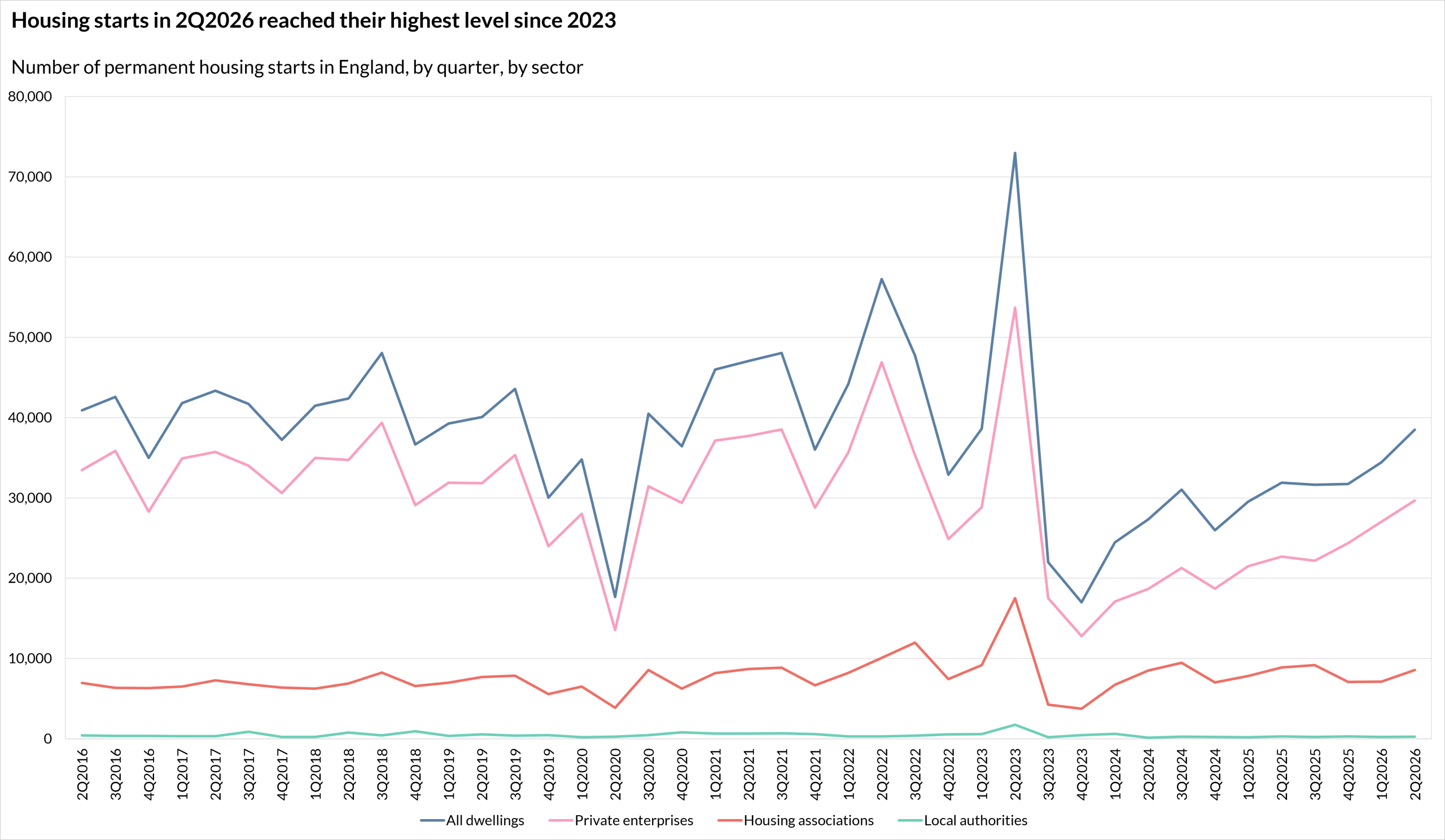
Source : ONS – Indicators of house building, UK: permanent dwellings started and completed by country, Tables 1a, 1b, 1c, 1d, 1e
On the completions side, England accounted for 83.6% of all completions in the UK in 2Q2026 with 37,530 recorded. Private enterprises were responsible for 72.6% of those with 27,250. Housing associations accounted for 9,880 completions in England, or just over one in four, while local authorities were responsible for 1.1%. Private enterprises carried out the lion’s share of completions across the rest of the UK, ranging from 79.8% in Wales to 86.0% in Northern Ireland.
| All housing completions | |||
| 2Q2026 | Change from 1Q2026 | Change from 2Q2025 | |
| UK | 44,870 | 12.3% | 0.0% |
| England | 37,530 | 11.2% | 1.4% |
| Wales | 1,190 | 11.2% | -3.3% |
| Scotland | 4,580 | 24.8% | -11.2% |
| Northern Ireland | 1,570 | 6.8% | 6.8% |
Source : ONS – Indicators of house building, UK: permanent dwellings started and completed by country, Tables 1a, 1b, 1c, 1d, 1e
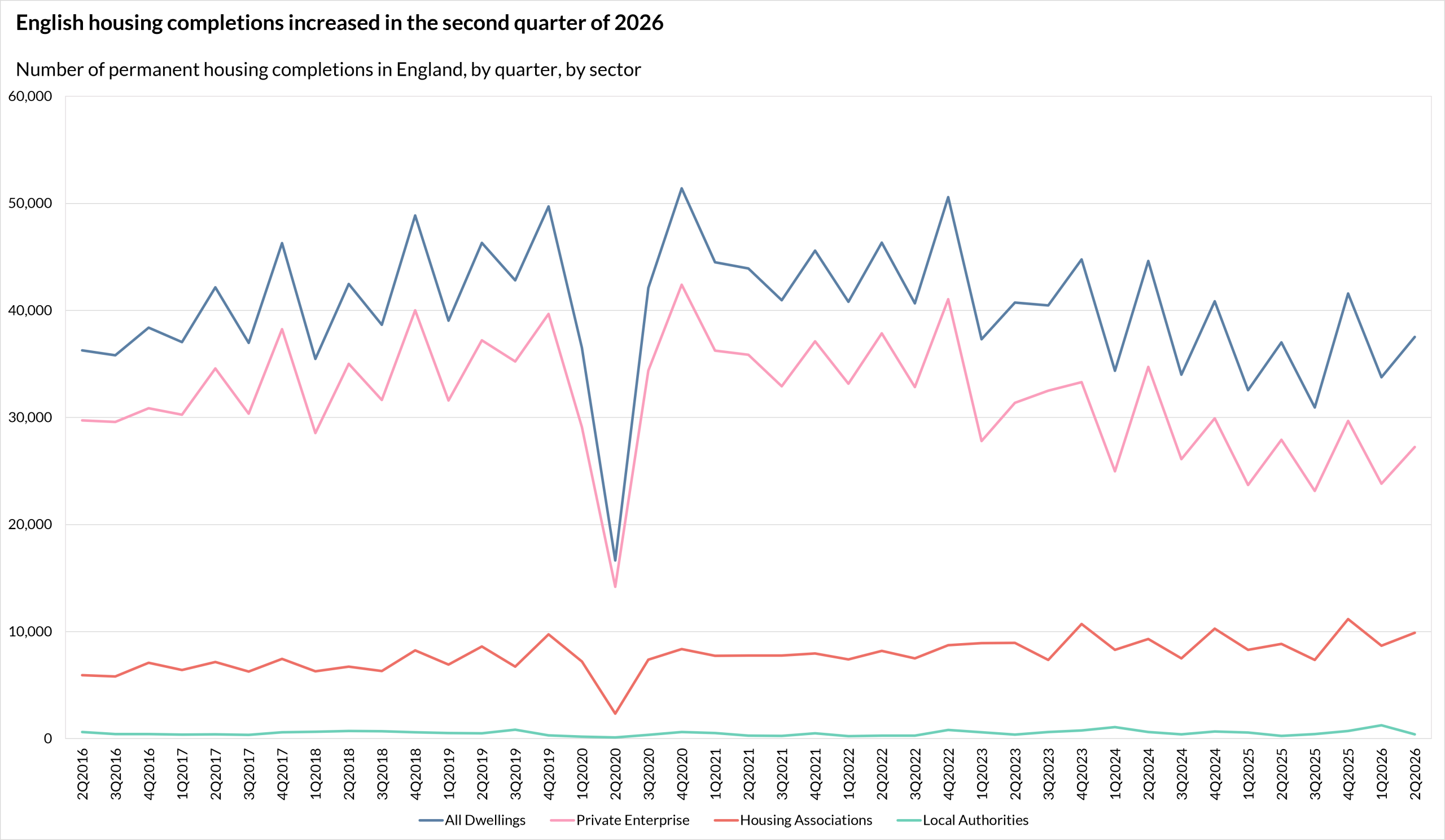
Source: ONS – Indicators of house building, UK: permanent dwellings started and completed by country, Tables 1a, 1b, 1c, 1d, 1e
To keep up to date with the latest industry news and insights from BCIS, register for our newsletter here.