The Building Cost Information Service (BCIS) is the leading provider of cost and carbon data to the UK built environment. Over 4,000 subscribing consultants, clients and contractors use BCIS products to control costs, manage budgets, mitigate risk and improve project performance.
Published: 19/08/2026
The Office for National Statistics (ONS) publishes quarterly data(1) measuring the number of employees and self-employed people in the UK by industry and gender. This data, which is not seasonally adjusted, is based on the Labour Force Survey (LFS) and aims to provide a current snapshot of employment trends and insight into the labour markets of specific industries.
In the last couple of years, ONS has made several changes to address quality concerns with the LFS(2) and caution has been advised in using these statistics.
ONS also publishes monthly data on the number of vacancies and jobs in the UK by industry(3). This data, which is seasonally adjusted, is based on the Vacancy Survey, a monthly survey of businesses that provides a comprehensive measure of the total number of vacancies across the economy.
Construction workforce sees small contraction in second quarter
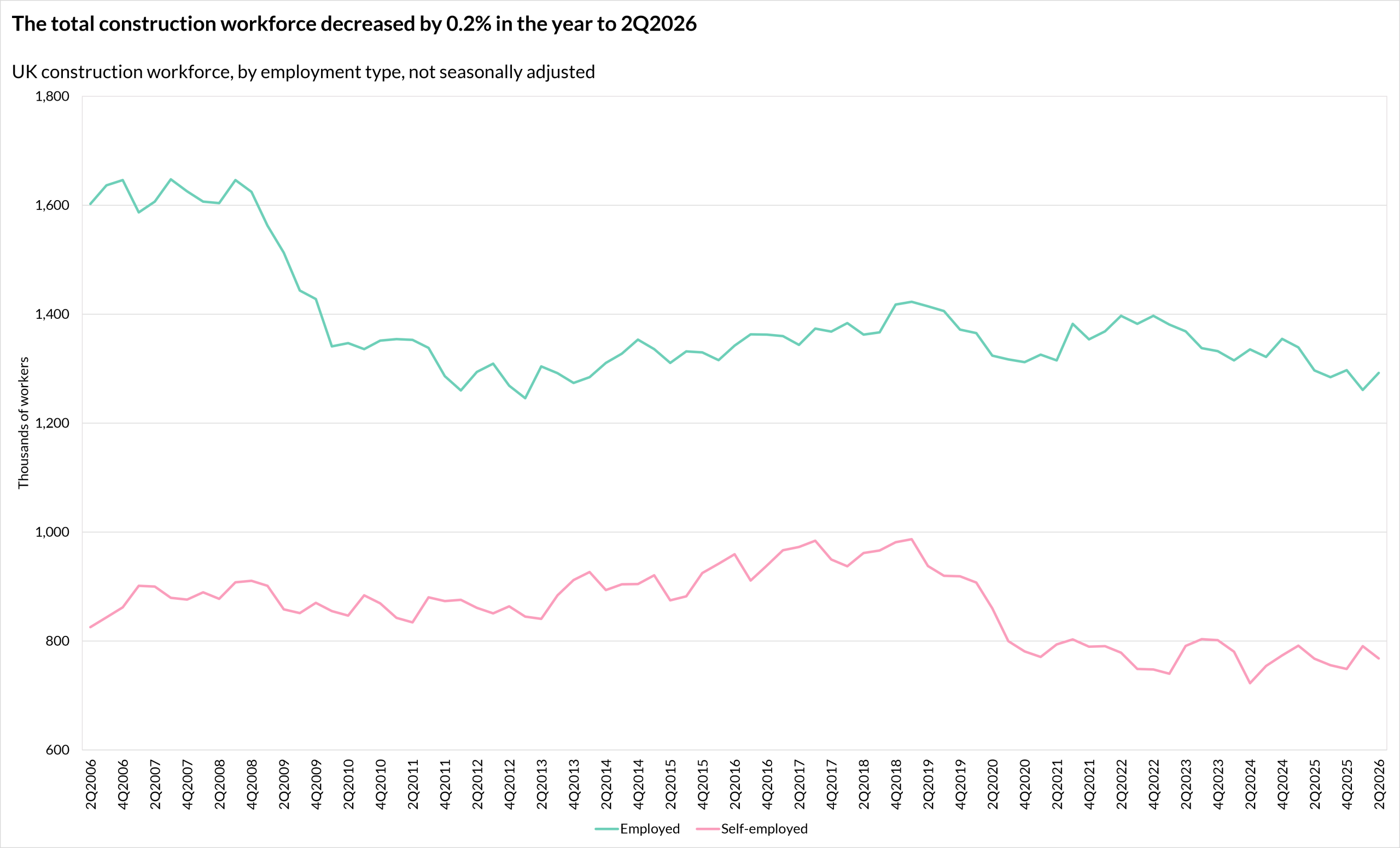
The UK construction workforce (not seasonally adjusted) was 0.2% smaller in 2Q2026 than it was in 2Q2025, new employment data from the ONS suggest.
A total of 2,060,284 people were estimated to be working in construction in the second quarter, which represents a 15.1% decline on the size of the workforce 20 years ago in 2Q2006.
Dr David Crosthwaite, chief economist at BCIS, said: ‘New data continue to reinforce the long-term decline in construction’s total workforce. Recent government-led investment in training and skills development has been welcome, but the challenge goes beyond state funding and the skills strategy. It’s also about ensuring the industry has the workload to support a growing workforce. In some areas of the market, employers simply don’t have the capacity or need to take on additional labour when demand isn’t there.
‘Moving forward, the government must match its skills initiatives with measures to ease cost pressures on businesses and, crucially, do what it can to stimulate demand for construction. It’s a difficult balance, but ultimately, directing more funding towards the skills agenda is not the answer in isolation.’
Employed and self-employed workers
In 2Q2026, there were an estimated 1,292,315 employed workers and 767,969 self-employed workers in construction. Self-employed workers accounted for 37% of the overall workforce.
The number of employed workers in 2Q2026 was down by 0.3% year-on-year while self-employed workers in construction increased slightly by 0.1%.
‘The data point to resilience in the self-employed segment of the workforce in the face of several economic headwinds,’ Dr Crosthwaite added. ‘This is promising given how important flexible labour is to the wider construction industry, particularly when workloads remain uneven and businesses need to adapt quickly to changing market conditions.
‘At the same time, the slight decline in employed workers suggests firms remain cautious about committing to permanent recruitment while project pipelines and viability are less certain.
‘This is less of a challenge while demand remains relatively soft, but any substantial increase in workloads could compound existing shortages, such as those in the finishing trades, and lead to delays or cost increases, particularly in areas where major projects draw heavily on limited labour pools.’
Source: ONS – EMP14: Employees and self-employed by industry.
Gender imbalance persists across construction workforce
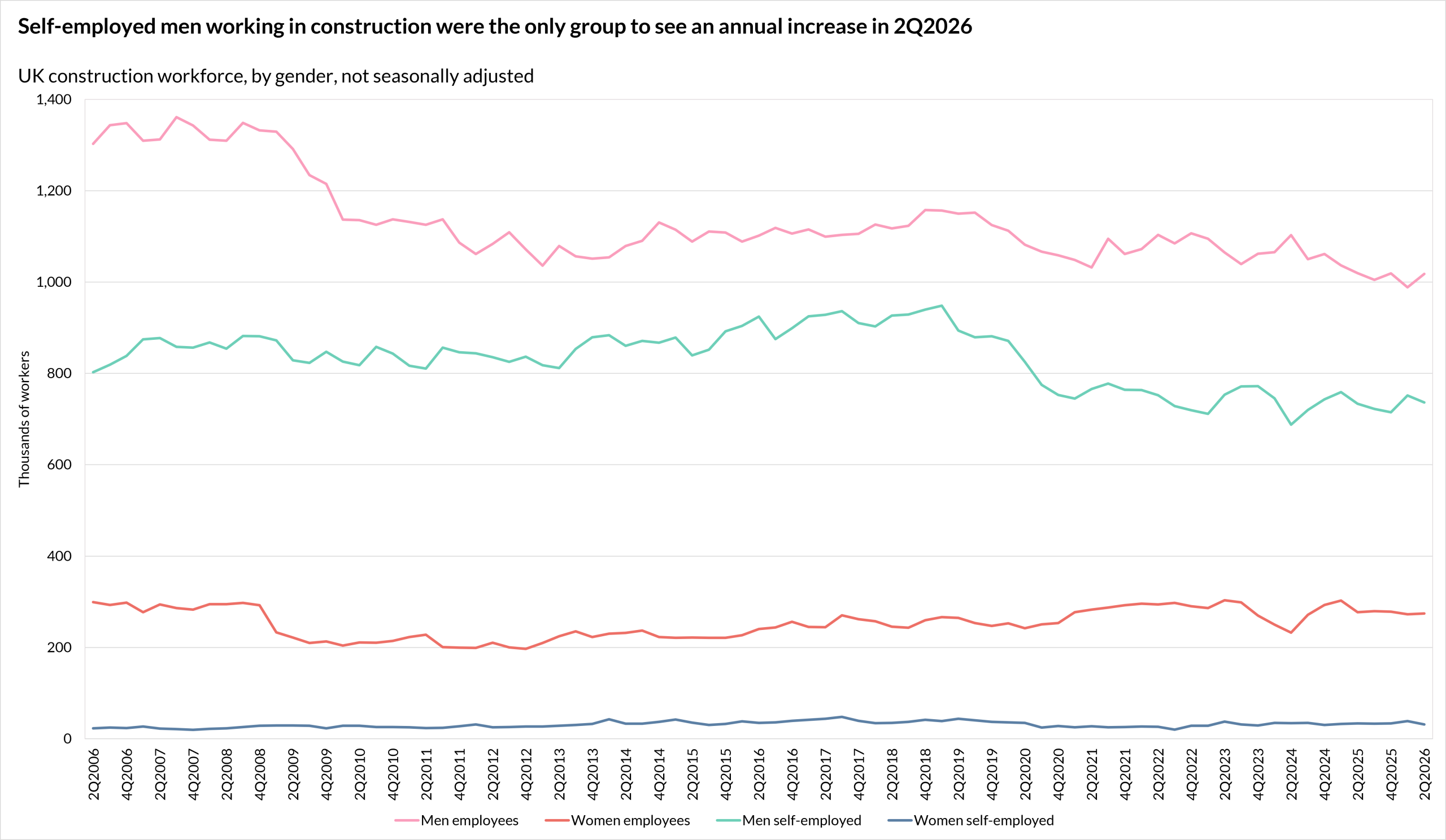
By gender, 85% of construction workers in 2Q2026 were men, with an estimated 305,850 women working in the sector in total.
| 2Q2026 | 2Q2025 | Change (y/y) | |
| Men employees | 1,018,084 | 1,019,530 | -0.1% |
| Women employees | 274,231 | 277,190 | -1.1% |
| Men self-employed | 736,350 | 733,712 | 0.4% |
| Women self-employed | 31,619 | 33,652 | -6.0% |
Source: ONS – EMP14: Employees and self-employed by industry.
Job vacancies in construction
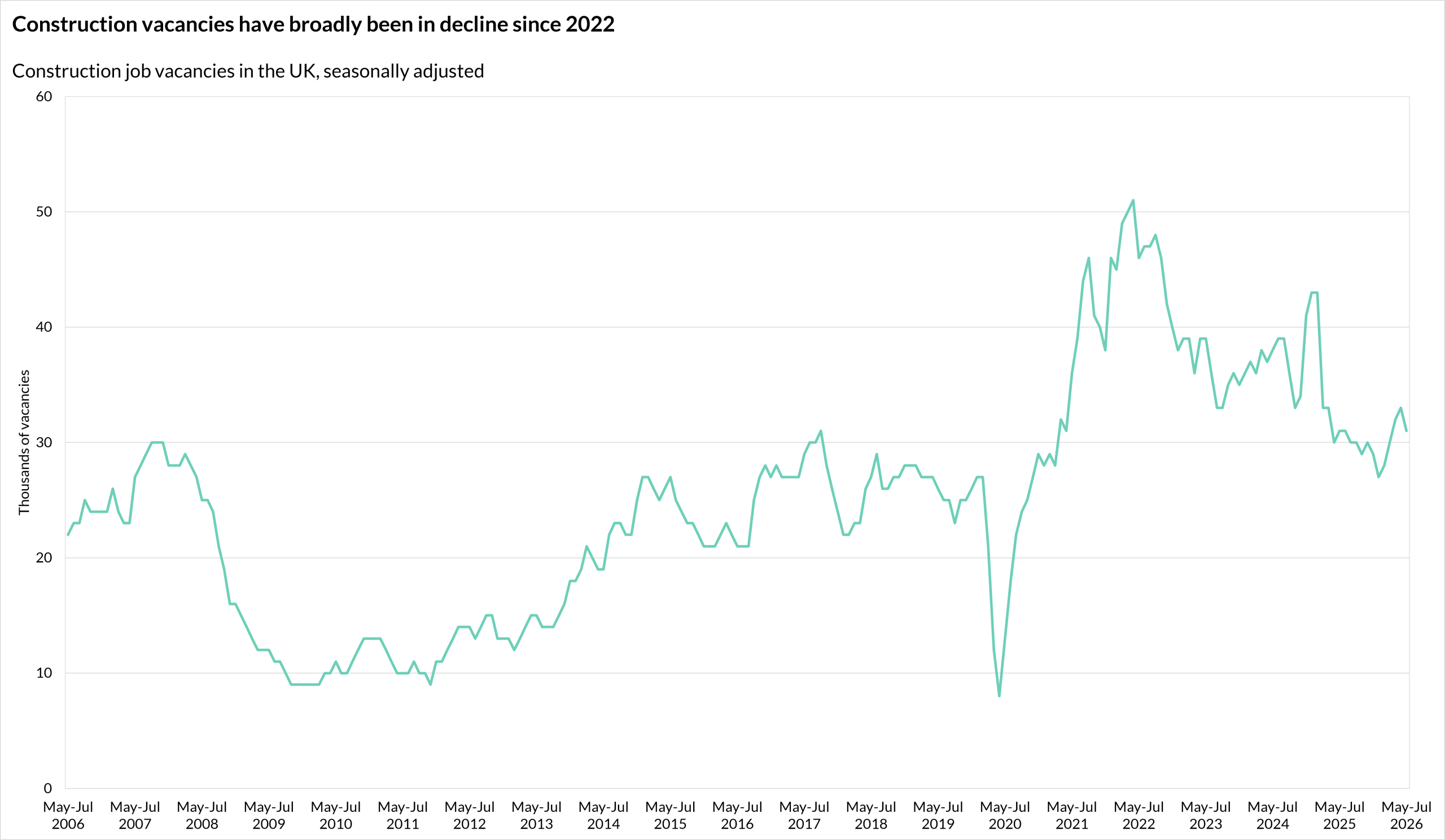
New figures from the ONS Vacancy Survey – a monthly survey that provides estimates of the number of available positions in the economy – show that in the three months to July 2026, there were an estimated 31,000 job vacancies in the construction sector (seasonally adjusted), at a ratio of 1.9 vacancies per 100 employee jobs.
The number of vacancies was unchanged compared with the same period in 2025.
Source: ONS – VACS02: Vacancies by industry.
‘Falling vacancies also point to a more cautious recruitment approach,’ Dr Crosthwaite said. ‘Weaker demand is part of the picture, but sustained cost pressures could also be forcing employers to make difficult decisions about where they invest, including in recruitment and training.
‘The Autumn Budget, due to be delivered on 28 October, is usually an important marker in the sand for clients and businesses alike. Once the new government administration sets out its priorities and how it intends to fund them, we’ll have a clearer sense of whether those decisions will strengthen confidence, improve the workload outlook and give businesses greater capacity to invest in employment.’
To keep up to date with the latest industry news and insights from BCIS, register for our newsletter here.