If you are a housebuilder or developer, please fill in the survey. If you have any questions or would like to discuss the survey, please call +44 0330 341 1000 or email contactbcis@bcis.co.uk
Published: 22/04/2026
Each month, Halifax, Nationwide and HM Land Registry publish house price indices, tracking the movement in average house prices in the UK. Halifax and Nationwide updates are based on mortgage approvals data, while the UK HPI is a joint production by HM Land Registry, Land and Property Services Northern Ireland, ONS and Registers of Scotland.
House price growth slows in March
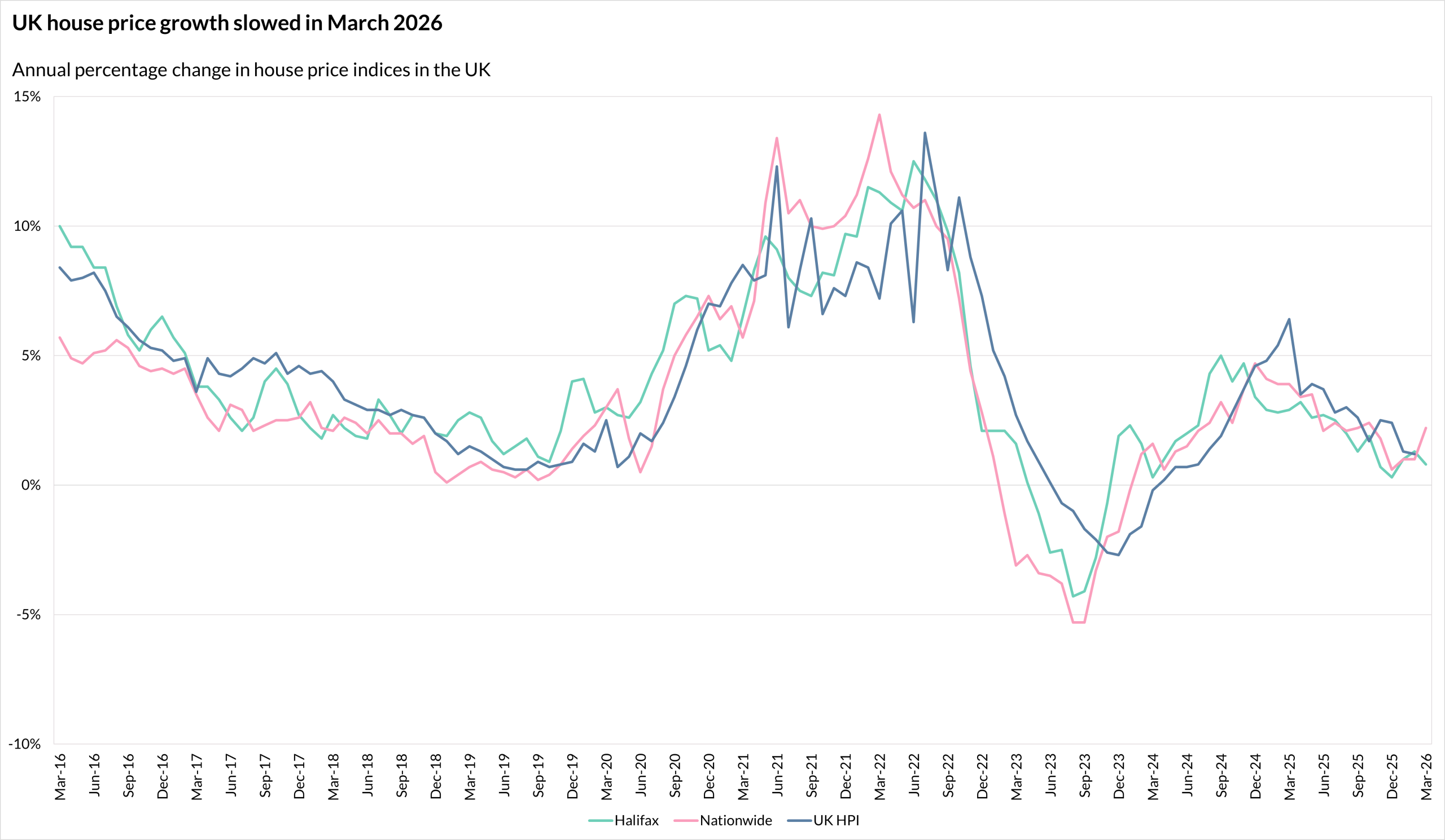
House prices increased in the year to March 2026, by 0.8% and 2.2% according to Halifax(1) and Nationwide’s(2) indices.
On a monthly basis, Halifax reported a 0.5% decrease in house prices in March while Nationwide reported a 0.9% increase.
Dr David Crosthwaite, chief economist at BCIS, said: ‘House price growth softened in March as the cost implications of the war in Iran fed through to inflation and interest rate forecasts. While the impact is not expected to be as severe as the fallout from Russia’s invasion of Ukraine, higher mortgage rates will slow activity as buyers reconsider purchasing decisions.’
According to the latest insight from the Financial Conduct Authority, which collects mortgage lending data via the Mortgage Lending and Administration Return(3), the value of new mortgage commitments (lending agreed to be advanced in the coming months) decreased by 11.9% in 4Q2025 from the previous quarter – the largest fall since 3Q2023.
Amanda Bryden, Head of Mortgages at Halifax, said the recent slowdown in the housing market reflects uncertainty regarding the conflict in the Middle East.
‘Concerns about higher energy prices have pushed up inflation expectations, which in turn led to a rise in mortgage rates, reducing confidence that interest rates will be cut this year and dampening the initial momentum in the market seen at the start of the year,’ she said.
Commenting further, Nationwide’s Chief Economist, Robert Gardner, said: ‘In the near term, UK economic growth is likely to be slower and inflation higher than previously expected, although ultimately the impact will depend on the duration of the shock as well as the policy response. The outlook for interest rates is particularly uncertain and dependent on whether the demand or supply side of the economy is more adversely affected.’
The UK HPI(4), with the latest data for February 2026, showed a 1.2% increase in house prices compared with February 2025, with a 0.1% rise on January 2026.
As the UK HPI figures cover house sales that may have been agreed in months previously, there tends to be a lag in the data.
Source: Halifax (Methodology), Nationwide (Methodology), UK HPI (Methodology)
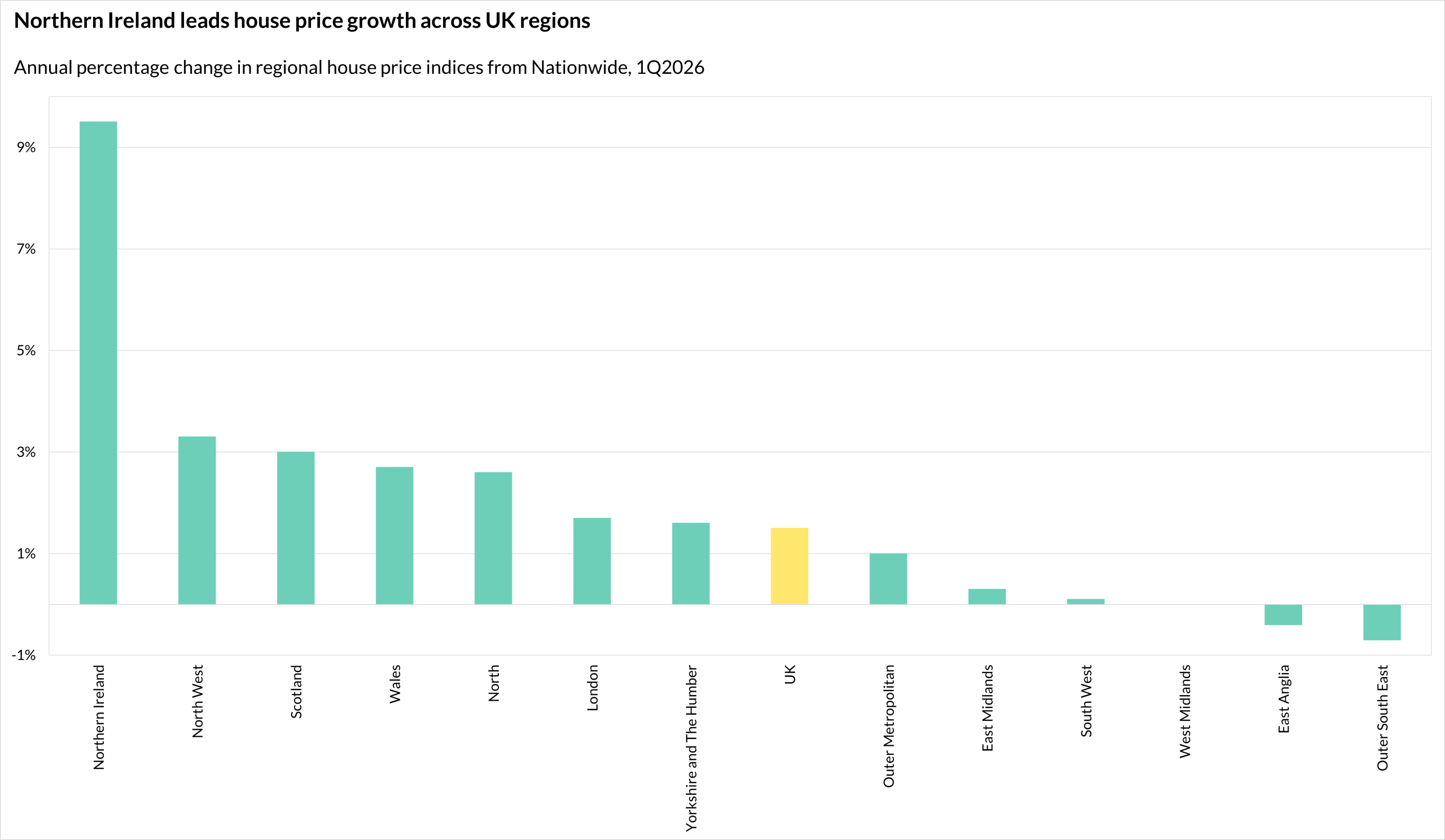
The latest regional data from Nationwide show Northern Ireland and the North West saw the greatest annual house price increases in 1Q2026, by 9.5% and 3.3% respectively.
East Anglia and the Outer South East were the only regions to experience a decrease on an annual basis, of 0.4% and 0.7% respectively.
In 1Q2026, the UK as a whole saw annual house price growth of 1.5% on the same quarter in 2025.
Source: Nationwide – Quarterly Regional House Price Statistics – Q4 2026
To keep up to date with the latest industry news and insights from BCIS, register for our newsletter here.