The Building Cost Information Service (BCIS) is the leading provider of cost and carbon data to the UK built environment. Over 4,000 subscribing consultants, clients and contractors use BCIS products to control costs, manage budgets, mitigate risk and improve project performance.
Published: 16/11/2026
The Office for National Statistics (ONS) publishes quarterly data(1) measuring the value and volume of main contractors’ new orders in Great Britain by sector and type of work. Its intention is to provide a forward-looking snapshot of both current confidence and potential future activity in the construction industry.
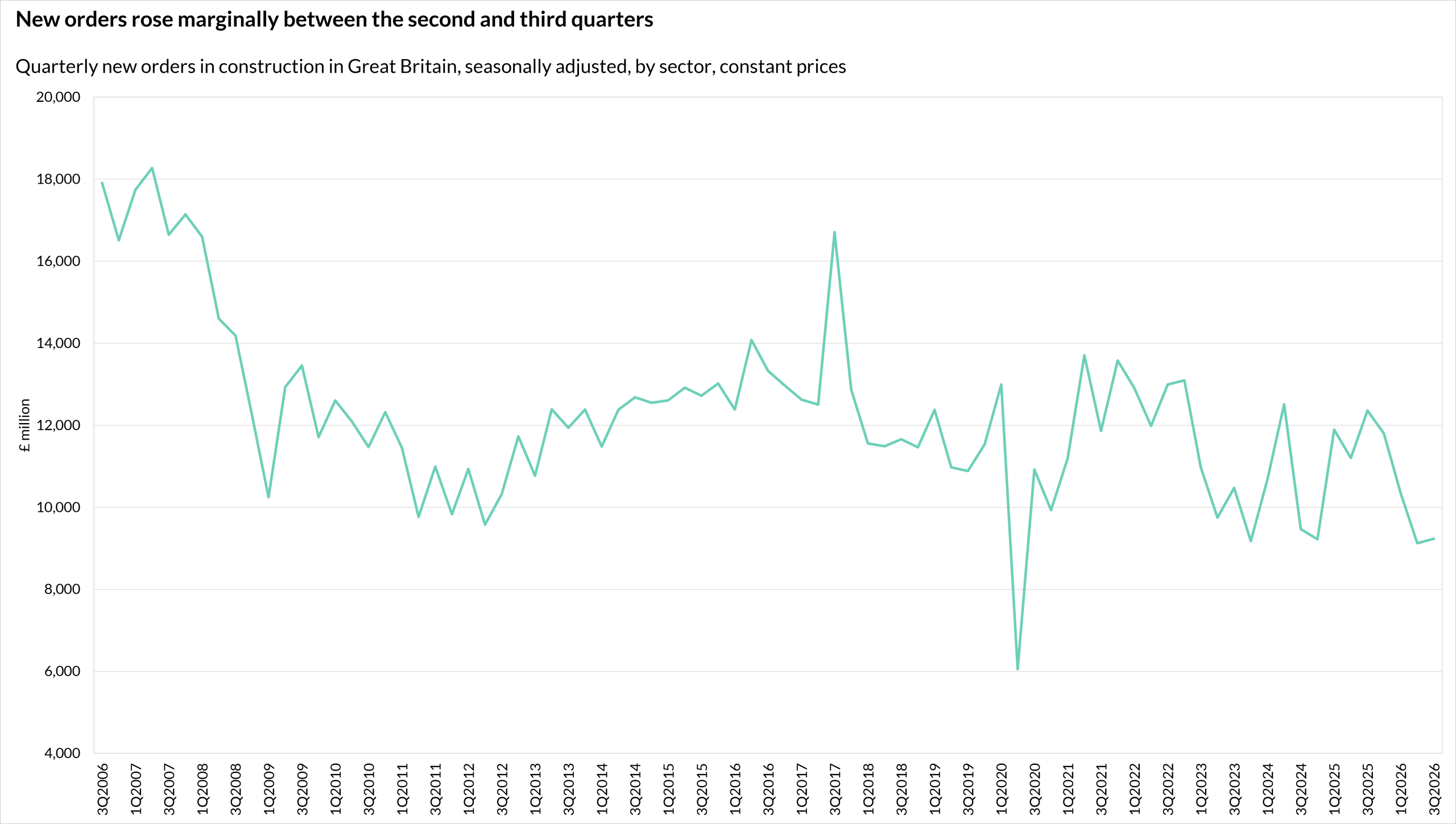
New orders decreased by one-quarter in year to 3Q2026
Total construction new orders increased by 1.2% in 3Q2026 compared with 2Q2026, with £9.2 billion of work committed, according to the latest ONS data. However, new orders were 25.3% lower than a year earlier and remained 15.2% below their pre-pandemic level in 2019.
The largest quarterly decline in new orders was recorded in the private industrial sector, at -24.6%, while public new work excluding housing and infrastructure saw the greatest increase, at 33.5%.
Public new work excluding housing and infrastructure also recorded the strongest annual growth in new orders in 3Q2026. Conversely, private industrial experienced the steepest annual decline, with new orders falling by 60.5%, or almost two-thirds, compared with 3Q2025.
Dr David Crosthwaite, chief economist at BCIS, said: ‘New orders data reflect the trends seen in the latest construction output figures. While annual orders for infrastructure and other public work excluding housing remained positive, this was not enough to offset significant declines across other sectors. The 25.3% annual fall in new orders for all work represents the steepest decline in quarterly orders since the end of 2023.
‘The Autumn Budget measures are likely to have limited impact in reversing this trend. The government seemed more concerned with appealing to the bond markets than delivering the bold interventions needed to stimulate construction demand and address the viability challenges facing the industry.
‘However, despite ongoing input cost and financing pressures, there is a strong case for progressing viable projects now rather than waiting for more favourable conditions. Inflationary pressures tend to become embedded in the economy, meaning construction costs are unlikely to return to the levels seen before the current Middle East conflict began.
‘For those involved in early cost planning and feasibility assessments, robust, construction-specific data will be essential to support and justify informed investment decisions. Understanding how construction costs could evolve will help build the case for moving forward with projects where the numbers stack up.’
| Sector | New orders in 3Q2026 compared with | |
| 2Q2026 | 3Q2025 | |
| Housing public | 13.7% | -13.4% |
| Housing private | -22.4% | -17.2% |
| Infrastructure | 7.9% | 0.3% |
| Public – other new work | 33.5% | 44.4% |
| Private industrial | -24.6% | -60.5% |
| Private commercial | 10.8% | -47.8% |
| All new work | 1.2% | -25.3% |
Source: ONS – New orders in the construction industry, Table 2
Source: ONS – New orders in the construction industry, Table 2
To keep up to date with the latest industry news and insights from BCIS, register for our newsletter here.
(1) Office for National Statistics – New orders in the construction industry - here